Disclosure: As an Amazon Associate, OfficialToddlerTech earns from qualifying purchases. This does not affect the price you pay.
Choosing volume-limiting headphones for kids in 2026 is less about chasing the most features and more about matching a child’s age, routine, and device setup to a model that is easy to live with. Some families need a simple wired headset for school. Others want wireless convenience for long car rides. A few need something more travel-focused, especially for planes and noisy shared spaces. The five options below are all built around that parent-first decision process, with strengths and limitations explained as plainly as possible.
Volume-Limiting Headphones For Kids In 2026: What Parents Should Compare
Quick Picks
If you want the shortest version, here is the basic ranking. The order reflects overall usefulness for most families, while still acknowledging that the “best” pick depends on how a child will actually use the headphones.
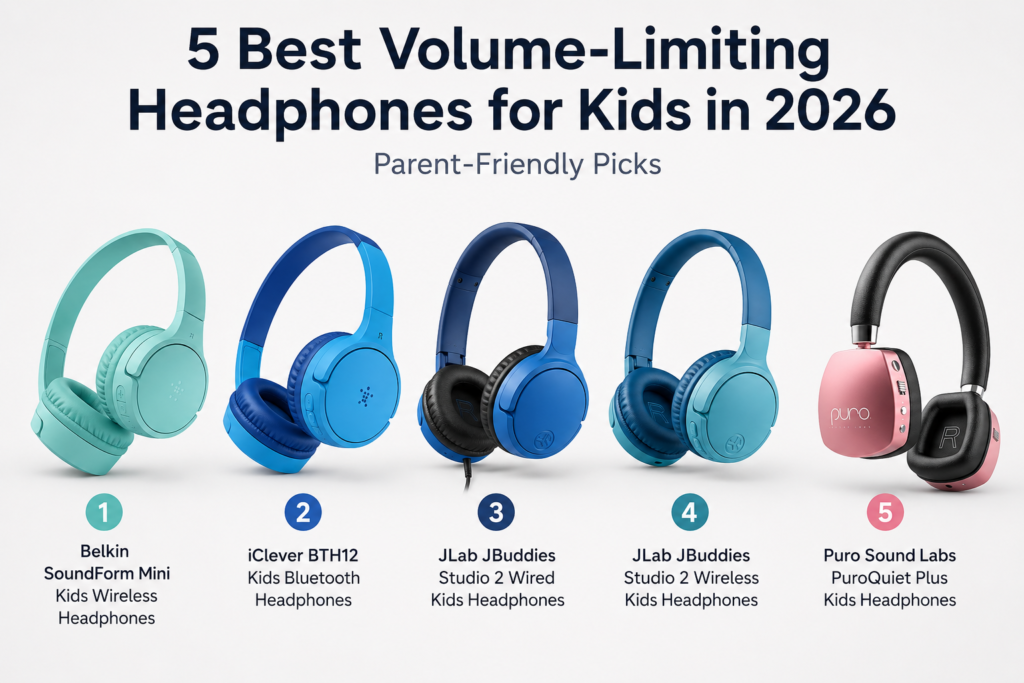
- Belkin SoundForm Mini Kids Wireless Headphones — a balanced all-purpose choice for school, home, and travel.
- iClever BTH12 Kids Bluetooth Headphones — a strong value pick with unusually long advertised battery life and two volume modes.
- JLab JBuddies Studio 2 Wired Kids Headphones — the simplest budget-friendly plug-in option.
- JLab JBuddies Studio 2 Wireless Kids Headphones — the best fit if your child needs long wireless battery life and modern charging.
- Puro Sound Labs PuroQuiet Plus Kids Headphones — the premium choice for families who care about noise reduction during travel.
That ranking is not a verdict on every child. For example, a wired model can be the most practical option for a classroom Chromebook, while a premium wireless model may make more sense for long flights. The goal is to avoid buyer regret by pairing the feature set with the real use case.
Comparison Table
| Product | Best for | Age range | Volume setup | Connection / power | Why a parent might choose it |
|---|---|---|---|---|---|
| Belkin SoundForm Mini Kids Wireless Headphones | Best Overall, Best for School | 3+ | 85 dB limit | Bluetooth 5.0, optional 3.5 mm wired connection, up to 30 hours battery life | Simple controls, flexible wired or wireless use, and a balanced fit for many routines |
| iClever BTH12 Kids Bluetooth Headphones | Best Value, Best for Long Trips | 4-14 | 74/85 dB modes; check the selected version | Bluetooth 5.2, up to 85 hours playtime | Extra-long battery life and two volume modes for families that want flexibility |
| JLab JBuddies Studio 2 Wired Kids Headphones | Best Budget Option, Best Wired Headphones | 6+ | 85 dB limit | Wired connection, braided cable | Low-cost plug-in convenience with no charging routine |
| JLab JBuddies Studio 2 Wireless Kids Headphones | Best Battery Life, Best Wireless Option | 6-16 | Selectable 85 dB and 95 dB modes | Bluetooth 5.3, USB-C charging, 65-plus hours playtime | Long battery life and modern charging for older kids who use headphones often |
| Puro Sound Labs PuroQuiet Plus Kids Headphones | Best Premium Option, Best for Air Travel | 5-14 | 85 dB limit | Bluetooth, active noise cancellation, up to 35 hours battery life | Travel-oriented noise reduction with a premium fit |
Detailed Reviews
1. Belkin SoundForm Mini Kids Wireless Headphones
The Belkin SoundForm Mini Kids Wireless Headphones are the most balanced pick in this group because they combine an 85 dB volume limit, wireless convenience, and an optional wired connection. For many parents, that flexibility matters more than a long feature list. A headset that works wirelessly on the couch but can also plug in for a school device or a long trip is often easier to keep in rotation.
Why parents may consider it: This model is built for designed for kids ages 3 and up, which makes it a useful middle-ground option for younger elementary school kids. The kid-sized cushioned ear cups and simple controls are likely to feel manageable for children who are still learning how to handle their own tech. The 30-hour battery life is also practical for school days and family travel without constant charging.
Key strengths:
- 85 dB volume limit for a more controlled listening ceiling.
- Wireless use with Bluetooth 5.0, plus an optional 3.5 mm wired connection.
- Up to 30 hours of battery life.
- Built-in microphone for calls or school-related communication needs.
- Simple controls that are easier for younger children to understand.
Important limitations: The charging port uses micro-USB rather than USB-C, which may matter if your family has already standardized on newer cables. The on-ear fit may feel small for older children, and current seller or color availability may vary. Also, the fit and format may not appeal to parents who strongly prefer over-ear headphones.
Buy this if: you want a straightforward, flexible headset for school, travel, and everyday use, and you value a balanced mix of simplicity and compatibility.
Skip this if: you want over-ear headphones, USB-C charging, or active noise cancellation.
2. iClever BTH12 Kids Bluetooth Headphones
The iClever BTH12 Kids Bluetooth Headphones stand out as a value-oriented option because they offer selectable 74 dB and 85 dB volume modes along with an advertised up to 85 hours of playtime. That combination is unusual in this category and may appeal to parents who do not want to think about charging as often. The colorful LED lighting adds a playful touch, though that same feature can also be a drawback in some settings.
Why parents may consider it: These headphones are aimed at ages 4 to 14, which gives them a wide age span. The lower 74 dB mode may be more appropriate for quieter environments, while the 85 dB mode provides a higher ceiling when needed. For families that travel often or use headphones at home, the very long battery life is the headline feature.
Key strengths:
- Multiple volume-limiting modes, including 74 dB and 85 dB; available settings may vary by version or market.
- Up to 85 hours of advertised playtime.
- Bluetooth 5.2 for wireless use.
- Fast charging.
- Built-in microphone.
- Over-ear design that may feel more secure for some children.
Important limitations: The LED lights may be distracting in classrooms or other low-distraction settings. The ear cups may feel bulky for very young children, and parents should confirm the selected volume mode before use rather than assuming it is set the way they want. Because the design is more feature-rich, it may be more than some families need for simple school listening.
Buy this if: you want a long-lasting wireless option with two volume settings and a travel-friendly battery profile.
Skip this if: classroom rules do not allow lights, or you want the smallest and simplest possible headset.
3. JLab JBuddies Studio 2 Wired Kids Headphones
The JLab JBuddies Studio 2 Wired Kids Headphones are the simplest pick in the roundup and a sensible option for families who do not want to manage charging or Bluetooth pairing. With an 85 dB volume limit, a braided cable, and a foldable design, they fit the classic school-headphone role without adding much complexity. For parents shopping around volume-limiting headphones for kids in 2026, that simplicity can be a real advantage.
Why parents may consider it: This model is recommended primarily for ages 6 and older, which aligns it more with school-age kids than preschoolers. If your child uses a Chromebook, classroom computer, or another device with a compatible port, a wired headset can be a dependable everyday solution. The braided cable may also hold up better than a thin standard cord in backpacks and classrooms.
Key strengths:
- 85 dB volume limit.
- No battery to charge and no Bluetooth pairing to manage.
- Lower-cost positioning than many wireless models.
- Braided audio cable for potentially better day-to-day durability.
- Foldable design for easier storage.
- Cloud Foam cushions and an in-line microphone.
Important limitations: The wired connection is less convenient for travel and movement than wireless headphones. It also requires a compatible headphone port or adapter, which can be a problem if your child’s device does not have one. Because the model is primarily recommended for children age six and older, it is not the most natural fit for toddlers or younger preschoolers.
Buy this if: you want a straightforward classroom or homework headset and you prefer a plug-in model with no battery routine.
Skip this if: your child’s device has no compatible audio port, or wireless use is essential.
4. JLab JBuddies Studio 2 Wireless Kids Headphones
The JLab JBuddies Studio 2 Wireless Kids Headphones are the strongest battery-life pick in the lineup for older children, with 65-plus hours of wireless playtime and USB-C charging. They also offer selectable 85 dB and 95 dB volume modes, plus a wireless sharing mode that lets two children listen together. That makes them especially appealing for school-age kids who move between devices, travel often, or want to share audio on the go.
Why parents may consider it: This model is recommended for ages 6 to 16, which gives it a broader school-age to teen range than many kid headphones. The combination of Bluetooth 5.3, foldability, and long battery life makes it practical for backpacks and frequent use. USB-C charging is also a plus for families already using newer chargers for phones, tablets, and other devices.
Key strengths:
- 65-plus hours of advertised wireless playtime.
- USB-C charging.
- Bluetooth 5.3.
- Wireless sharing mode for two listeners.
- Foldable design for easier transport.
- Built-in microphone.
Important limitations: The optional 95 dB setting is louder than many parents may want in a kids headset, so this is not the most conservative choice if your main goal is to keep volume as low as possible. It is also recommended more for school-age children than toddlers, and the on-ear cushions may not suit every child’s preference or head shape.
Buy this if: you want a long-lasting wireless headset for an older child and you like the convenience of USB-C and audio sharing.
Skip this if: you want a permanently fixed 85 dB limit or headphones aimed mainly at preschool children.
5. Puro Sound Labs PuroQuiet Plus Kids Headphones
The Puro Sound Labs PuroQuiet Plus Kids Headphones are the premium choice here, and the main reason parents may choose them is active noise cancellation. For air travel and other loud environments, that feature can make listening more comfortable without needing to push volume levels higher. This model still includes an 85 dB volume limit, which gives it the same basic listening ceiling as several other options in this roundup, but it adds a different kind of value through noise reduction.
Why parents may consider it: These headphones are designed for ages 5 to 14 and offer up to 35 hours of battery life, which is enough for extended travel without requiring constant charging. The lightweight on-ear design and padded fit suggest a more refined build than basic budget models. For families who spend time on planes, in busy cars, or in noisy public spaces, that travel-first design may be worth the premium positioning.
Key strengths:
- 85 dB volume limit.
- Active noise cancellation.
- Up to 35 hours of battery life.
- Bluetooth connectivity.
- Built-in microphone.
- Lightweight on-ear design with padded fit.
Important limitations: This is the most premium option in the group, so it is not the obvious budget pick. Active noise cancellation can also reduce awareness of surrounding sounds, which some parents may not want in every setting. And like other on-ear models, the fit may not work equally well for every child.
Buy this if: you want a travel-focused headset and active noise cancellation is a meaningful part of the decision.
Skip this if: you are shopping on a budget or you want a child to stay more aware of their surroundings.
How to Choose
When comparing volume-limiting headphones for kids in 2026, the most useful question is not “Which one has the most features?” It is “Which one will my child actually wear without frustration?” A headset can look great on paper and still be a poor fit if the child needs something simpler, smaller, or easier to use with their devices.
Start with age and fit. The age ranges matter because they give a rough clue about head size, control complexity, and likely comfort. The Belkin model reaches down to age 4, while the JLab wired and wireless models are aimed more at ages 6 and up. If you are buying for a younger child, simpler controls and a smaller fit may matter more than long battery life.
Then decide wired versus wireless. Wired headphones are often easier for classrooms and one-device households because there is no battery to manage. Wireless headphones reduce cord clutter and can be better for cars, flights, and general movement. If the child will use the headphones with a Chromebook or another school device, check the connection type first so you do not end up with a headset that needs an adapter you did not plan for.
Look closely at the volume limit. Several models in this roundup offer an 85 dB cap, while the iClever BTH12 includes a lower 74 dB mode and the JLab wireless model also includes a 95 dB option. Parents who want a more conservative setting may prefer a model with a lower selectable mode or a fixed 85 dB limit. Parents should also remember that any limit depends on the selected mode and how the headset is used, so it is worth checking the setting before handing it over.
Battery life should match routine, not marketing. A long battery claim is helpful only if it fits how often the child will use the headphones. The iClever model’s very long advertised battery life may be ideal for families who travel often or forget to charge. The Belkin’s 30 hours is more than enough for many school and home routines. The PuroQuiet Plus offers a middle ground with travel-oriented noise cancellation and a 35-hour battery.
Finally, think about extras honestly. LED lights, wireless sharing, microphones, and foldable frames can all be helpful, but each one can also add complexity or reduce the chance that the headphones will be the right everyday match. A feature only counts if it supports your family’s actual routine.
Frequently Asked Questions
Are volume-limiting headphones the same as safe headphones?
No product can promise perfect safety in every situation. Volume-limiting headphones are designed to cap listening levels, but parents still need to consider how long a child listens, what volume mode is selected, and whether the headset fits correctly. They can be a helpful tool, but they are not a substitute for supervision and common-sense listening habits.
Which is better for school: wired or wireless?
There is no one correct answer. Wired headphones are often simpler for classroom devices because they do not need charging. Wireless headphones are more convenient when a child moves around more or uses the same headset at home, in the car, and on trips. If school compatibility is your main concern, the wired JLab model or the wired/wireless Belkin option may be easier to manage.
Do I need active noise cancellation for kids?
Not necessarily. Active noise cancellation can be useful in very loud places such as airplanes, but it is not essential for every family. It may also reduce awareness of surrounding sounds, which is worth considering if you want a child to stay more aware in shared environments. The PuroQuiet Plus is the only model here with that feature, so it is best viewed as a travel-specialist choice rather than a universal requirement.
Which option is best for a younger child?
For younger children, the Belkin SoundForm Mini and the iClever BTH12 are the two most age-friendly choices in this list because their ranges start at age 4. The Belkin is simpler overall, while the iClever offers more battery life and a lower 74 dB mode. The right answer depends on whether you want straightforward controls or more flexibility.
What should I watch for before buying?
Check the child’s device connection type, the headphone’s age range, whether the volume setting is fixed or selectable, and whether the fit is likely to be comfortable. Also consider whether features like LED lights, ANC, or wireless sharing will actually help or just create extra complexity. Those are often the details that determine whether a headset gets used regularly.
Final Recommendations
If you want the easiest all-around pick, the Belkin SoundForm Mini Kids Wireless Headphones are the strongest starting point because they combine an 85 dB limit, wireless convenience, and an optional wired connection in a kid-friendly package. If your family is focused on value and battery life, the iClever BTH12 offers the most striking endurance and flexible volume modes. If you need a simple school headset with no charging, the JLab JBuddies Studio 2 Wired model is the cleanest budget choice.
For older children who use headphones often, the JLab JBuddies Studio 2 Wireless model is the most practical long-battery wireless option, especially with USB-C charging. And if your main concern is travel noise, the Puro Sound Labs PuroQuiet Plus deserves attention for its active noise cancellation and premium fit. The best volume-limiting headphones for kids in 2026 are the ones that match the child’s routine first and the feature list second.
Last updated: June 2026
OfficialToddlerTech participates in the Amazon Services LLC Associates Program. As an Amazon Associate, we earn from qualifying purchases. Product prices and availability may change. Please check the retailer page for the latest details.
Related guide: 5 Best Coding Toys for Kids in 2026