Disclosure: As an Amazon Associate, OfficialToddlerTech earns from qualifying purchases. This does not affect the price you pay.
If you are trying to figure out how to choose screen-free audio players for kids, the easiest place to start is not with brand names but with your child’s routine. A good fit for bedtime is not always the best fit for travel, and a device that is simple for a preschooler may feel too limited for an older child. The right choice usually comes down to age fit, how content is loaded, how independent your child should be, and whether you want a toy-like experience or a more portable player.
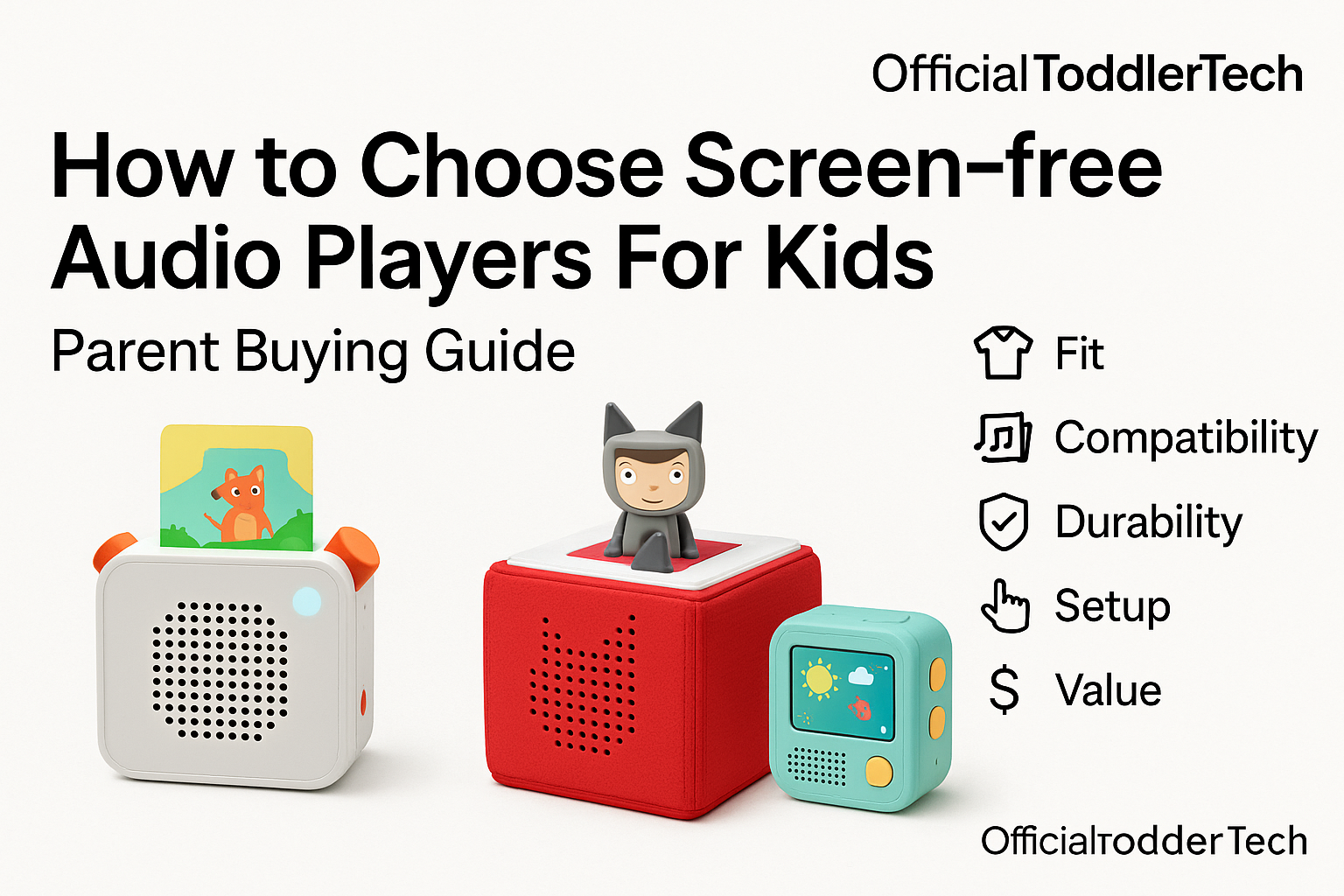
This guide uses three examples to show what those tradeoffs look like in real life. The goal is not to crown one universal winner. It is to help you spot the kind of player that matches your family before you buy.
Buying Checklist
Before comparing models, use this checklist to narrow the field. In practice, how to choose screen-free audio players for kids is mostly about matching the device to the child, not just the feature list.
- Start with the child’s age and independence level. A younger child may do better with physical, easy-to-understand controls. An older child may want something they can manage with less parent help.
- Think about where it will be used. Bedside use, car rides, travel, and quiet play all favor different shapes and control styles.
- Decide how you want content handled. Some players use cards or figurines, while others rely on an ecosystem of content. That can be a plus if you want structure, or a downside if you want less to manage.
- Look at the control style. Tap, card, figurine, or buttons all change how easy the player is for a child to understand without a screen.
- Check portability honestly. A device can be “portable” in marketing terms without being easy to pack, carry, or use in a moving car.
- Consider who will set it up. If you want something a grandparent or babysitter can use without extra explanation, simpler is usually better.
- Weigh the ecosystem. Some families like a built-in system of cards or characters. Others prefer to avoid content systems that require ongoing add-ons.
- Plan for the regret risk. The most common mistake is buying for a hypothetical future use case instead of the one your child actually has now.
| What to prioritize | Best fit tends to look like | Potential drawback |
|---|---|---|
| Independent listening | Simple controls and child-owned playback | Less flexibility if the ecosystem is narrow |
| Bedtime routines | Easy-to-repeat audio and predictable operation | May be less portable or less exciting for travel |
| Travel | Compact design and low setup friction | Smaller devices can still depend on content systems |
| Giftability | Simple starter set with obvious use | May lock you into add-on content or accessories |
What Matters Most
When parents ask how to choose screen-free audio players for kids, the most useful answer is usually “choose the control model first.” That is because controls shape everything else: how quickly your child learns the device, how much help you will need to give, and how flexible the player feels in daily use.
1. Age range is only the starting point
The supplied products are positioned for ages 3 to 12+, but that does not mean every child in that range will use them the same way. A three-year-old may enjoy a physical, toy-like interaction and need more adult help. An older child may want faster access to stories or music and may be more sensitive to anything that feels too “babyish.” Age labeling helps, but routine and temperament matter just as much.
2. Physical interaction can reduce friction
Some audio players lean on cards, while others use figurines or buttons. That can be ideal if you want a child to understand the device without reading menus or staring at a screen. The tradeoff is that physical systems can also mean more pieces to keep track of. If your family loses small items easily, an accessory-driven setup may become annoying.
3. Ecosystem simplicity versus ecosystem flexibility
One of the biggest buyer-regret risks is underestimating the content ecosystem. A device with cards or figurines can feel delightfully simple when it works the way your child expects. But it can also mean you are managing extra content pieces instead of just having a single player. Families who want one self-contained object often feel better with the simplest setup they can find.
4. Portability is about more than size
Travel-friendly does not just mean compact. It also means your child can use it in a car seat, at a hotel, or at a grandparent’s house without a complicated setup. A player that depends on multiple add-ons may still be portable, but it may not be effortless. If you are buying for trips, think about packing, charging, and keeping track of the pieces together.
5. Independent use is not the same as adult-proof use
Some screen-free audio players are made so a child can control them without a tablet or phone. That is helpful, but it does not guarantee that every age will operate them the same way. If your child is easily frustrated, look for the simplest path from “turn on” to “play audio.”
Use the product examples below as decision tools, not as a ranked list. Each one highlights a different buying criterion you may care about.
Product Examples
Yoto Player (3rd Generation)
Decision criterion it illustrates: Independent screen-free listening with a kid-centered audio system.
The Yoto Player (3rd Generation) is positioned as a screen-free audio player for kids ages 3 to 12+. Official brand materials describe it as ad-free and kid-controlled, which makes it a strong example for families who want a child to handle playback with less adult intervention. Its card-based format may appeal if you want audio to feel structured and easy to start.
Tradeoff: The same card-based system that makes it easy to understand can also mean you are managing cards instead of one fully standalone player. The supplied catalog data also notes that Amazon product-page specifics could not be fully verified from search results alone, so this is not the right choice for parents who want every detail fully confirmed on the retail listing before deciding.
Who should skip it: Skip it if you want a fully verified Amazon listing with visible on-page specs, or if you want to avoid any product where recall-history concerns are unresolved.
Families who want a purpose-built player for independent listening, bedtime stories, or school-age travel audio may find this model especially relevant when deciding how to choose screen-free audio players for kids.
Toniebox 2 Audio Player Starter Set
Decision criterion it illustrates: Hands-on, toy-like listening that is easy for younger kids to understand.
The Toniebox 2 Audio Player Starter Set is designed for children ages 1 and up and is a useful example if your main goal is to make audio feel playful and easy to grasp. Official support materials confirm the ecosystem and setup, and the figurine-based approach gives children a physical object to place on the player. That can be an intuitive introduction to screen-free listening for toddlers, preschoolers, and younger elementary-age children.
Tradeoff: The structure that makes it fun can also create dependence on proprietary figurines and accessories. That is not necessarily a problem if you like collecting and expanding content, but it can be a downside if you want a simple player with no character ecosystem to manage.
Who should skip it: Skip it if you want an all-in-one player without a content ecosystem, or if you know your family prefers fewer small add-on pieces.
This model is especially helpful for parents who want a giftable starter set and are weighing how much structure they want built into the listening experience.
Yoto Mini (2024 Edition) + Make Your Own Card
Decision criterion it illustrates: Travel-friendly portability in a screen-free audio player.
The Yoto Mini Player (2024 Edition) is the example to study if your biggest concern is taking audio on the go. It is described as a portable screen-free audio player that plays Yoto cards and includes Bluetooth and Wi-Fi connectivity. That combination suggests a player designed for families who want something compact enough for travel while still keeping the listening experience separate from a screen.
Tradeoff: The Mini still depends on Yoto cards or app-managed content for full use, so portability does not equal simplicity in every case. The supplied product data also notes a small-parts warning, which means it is not suitable for children under 3. If you are buying for a younger sibling, that matters.
Who should skip it: Skip it if you want a fully self-contained device with no ecosystem, or if your child is under 3.
If your main question is how to choose screen-free audio players for kids for travel, car rides, or quiet independent time away from home, this is the product example that best shows the portability tradeoff.
Frequently Asked Questions
What is the biggest mistake parents make when buying one of these?
The most common mistake is focusing on the idea of screen-free listening instead of the practical details. A device may sound perfect in theory, but if the controls are awkward for your child, the content ecosystem feels cumbersome, or the size does not work for travel, it may not get used much.
Should I choose a card-based player or a figurine-based one?
Choose the one that best matches how your child naturally plays. Card-based systems can feel orderly and easy to organize. Figurine-based systems can feel more like a toy and may be more intuitive for some younger children. The tradeoff in both cases is managing extra content pieces.
Do I need a portable model if we already have a bedtime player?
Not always. If the main use is bedtime, a larger or more room-based player may be fine. Portable models matter most if you plan to use the device in cars, hotels, or multiple homes. When thinking about how to choose screen-free audio players for kids, use-case fit matters more than having the smallest device available.
Are these good gifts for every child in the age range?
Not automatically. A child’s interest in physical controls, character-based content, or independent playback matters a lot. Two children in the same age bracket may respond very differently to the same device. A gift is more likely to land well when it matches the child’s routine and preferences.
Should I worry about extra accessories?
Yes, if your family prefers fewer parts to manage. Accessories can be part of the fun, but they also add to the risk of lost pieces or ongoing content purchases. If that sounds frustrating, lean toward the simplest model that still fits your child’s daily use.
Final Checklist
Before you buy, run through this short checklist one more time. It is the practical version of how to choose screen-free audio players for kids without getting distracted by marketing language.
- Does the player fit your child’s age and attention span?
- Will your child be able to use it with minimal help?
- Do you want cards, figurines, or a simpler playback style?
- Will it be used mostly at bedtime, at home, or during travel?
- Are you comfortable managing an ecosystem of content pieces?
- Does the size and setup match the place you will actually use it?
- Have you thought about the downside as carefully as the upside?
If you answer those questions honestly, the best choice usually becomes clearer. For some families, that will be the Yoto Player (3rd Generation). For others, the Toniebox Audio Player Starter Set will be the better fit because it feels more playful. And for travel-focused families, the Yoto Mini Player (2024 Edition) may be the most sensible example of a compact, kid-centered audio device.
The right screen-free player is the one your child can actually use, not just the one with the most appealing description. That is the heart of how to choose screen-free audio players for kids in a way that avoids regret later.
Already deciding between Yoto and Toniebox? Read our full ecosystem comparison.
Last updated: June 2026
OfficialToddlerTech participates in the Amazon Services LLC Associates Program. As an Amazon Associate, we earn from qualifying purchases. Product prices and availability may change. Please check the retailer page for the latest details.